
AHS-P1-6. Japanese Recreational Swimming Rate
Jordan Minamide1
Ryo Hongo2
Faculty Mentor: Kimberly Nehls, Ph.D.1
1Lee Business School, Department of Marketing and International Business
2Lee Business School, Department of Accounting
ABSTRACT
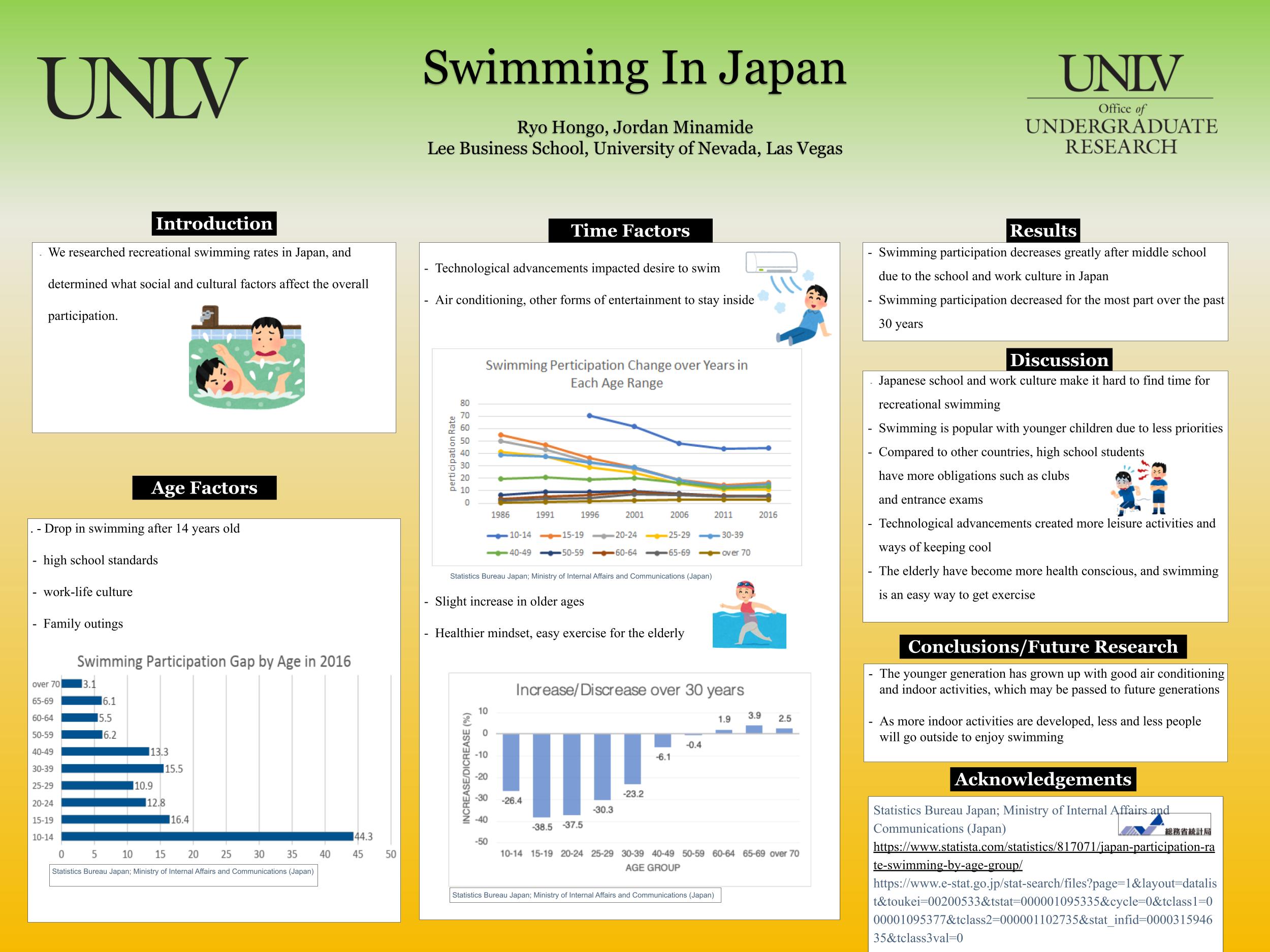
Looking at recreational swimming trends based on age tells us a lot about the priorities that Japanese people have as they grow older. In addition, the amount of recreational swimming has changed a lot in the past 30 years. The numbers for swimming drop significantly as people get older in Japan, as well as have dropped by over 50% in the past 30 years for most age ranges.
Looking at various data sets from surveys conducted by the Ministry of Internal Affairs in 2016, we see that the amount of swimming drops dramatically after age 14, and the amount of swimming has also been decreasing since 1986 for some age groups, and increasing for others. For each age range, this drop shows Japanese school and work culture, where there is little time for recreational swimming. Most middle schools have their own pool where kids can swim. However, in high schools clubs and extra classes take significant time from students. At work, people stay for long hours, and rarely have time to go to public pools.
Since 1986, the amount of swimming has decreased a lot for most age ranges because there are other activities available such as indoor activities due to better air conditioning. There is an exception to this though. The amount of recreational swimming for people over 60 has slightly increased because the older population is becoming more health conscious. This data represents the Japanese lifestyle, and gives an insight of the culture surrounding recreational activities in Japan.
Date
- Nov 15 - 19 2021
- Expired!
Time
- All Day
Labels
- AHS: Poster Session 1

Organizer
-
The Office of Undergraduate Research
-
Phone
702-895-4771 -
Email
our@unlv.edu -
Website
http://unlv.edu/our
Speakers
-
Dr. Kimberly Nehls | Lee Business School
-
Jordan Minamide | Lee Business School
-
Ryo Hongo | Lee Business School
