AHS-P7-5. Telecommuting The Future Towards Better Air Quality: A Case Study of India


Harmony Ruth1, 2
Faculty Mentor: Kimberly Nehls, Ph.D.2
1Lee Business School, Department of Economics
2Lee Business School, Department of Marketing and International Business

ABSTRACT
This study aims to answer the question on whether telecommuting offers a plausible and desirable solution to mitigating air pollution in India’s largest cities by looking at the causes of air pollution, its change during the pandemic, and how popular a remote work option is among India’s educated class. With a burgeoning population of over 1.3 billion people and accompanying growth in their services sectors, remote work has already been on the rise within the country and there are promising projections for its growth. Current research on the improved environmental quality during the pandemic largely focuses on the shut-down of the industrial sector with little attention paid to the impact traffic congestion has on impairing air quality. This paper finds that lessening traffic congestion in India’s cities leads to better air quality but may not be the most popular among workers and has overall significance for the health and safety of India’s citizenry if policies are utilized to promote remote work.

AHS-P4-6. Second Ground Zero: The Impact of the Early Stages of COVID-19 on Italy, and its Future Mitigation


Christopher Puga1
Faculty Mentor: Kimberly Nehls, Ph.D.2
1Lee Business School, Department of Accounting
2Lee Business School, Department of Marketing and International Business

ABSTRACT
When COVID-19 was first discovered, the extent of its possible impact was still unknown. Unfortunately, Italy was one of the first major countries to suffer from the effects of COVID-19. At the time, there was no accessible testing, standard protocol, or vaccines. Upon easing initial restrictions, Italy was faced with a second wave. However, once protocols were re-introduced, the spread was mitigated again. Italy is a visual case in understanding the extent of the impact COVID-19 can have, as well as providing an understanding of the importance of accessible testing, standard protocol, and vaccines as it relates to the mitigation of the effects of COVID-19. By viewing Italy’s COVID-19 case statistics, it can be concluded that it is possible to mitigate the spread of COVID-19 and control its effects on major countries.

AHS-P1-6. Japanese Recreational Swimming Rate


Jordan Minamide1
Ryo Hongo2
Faculty Mentor: Kimberly Nehls, Ph.D.1
1Lee Business School, Department of Marketing and International Business
2Lee Business School, Department of Accounting

ABSTRACT
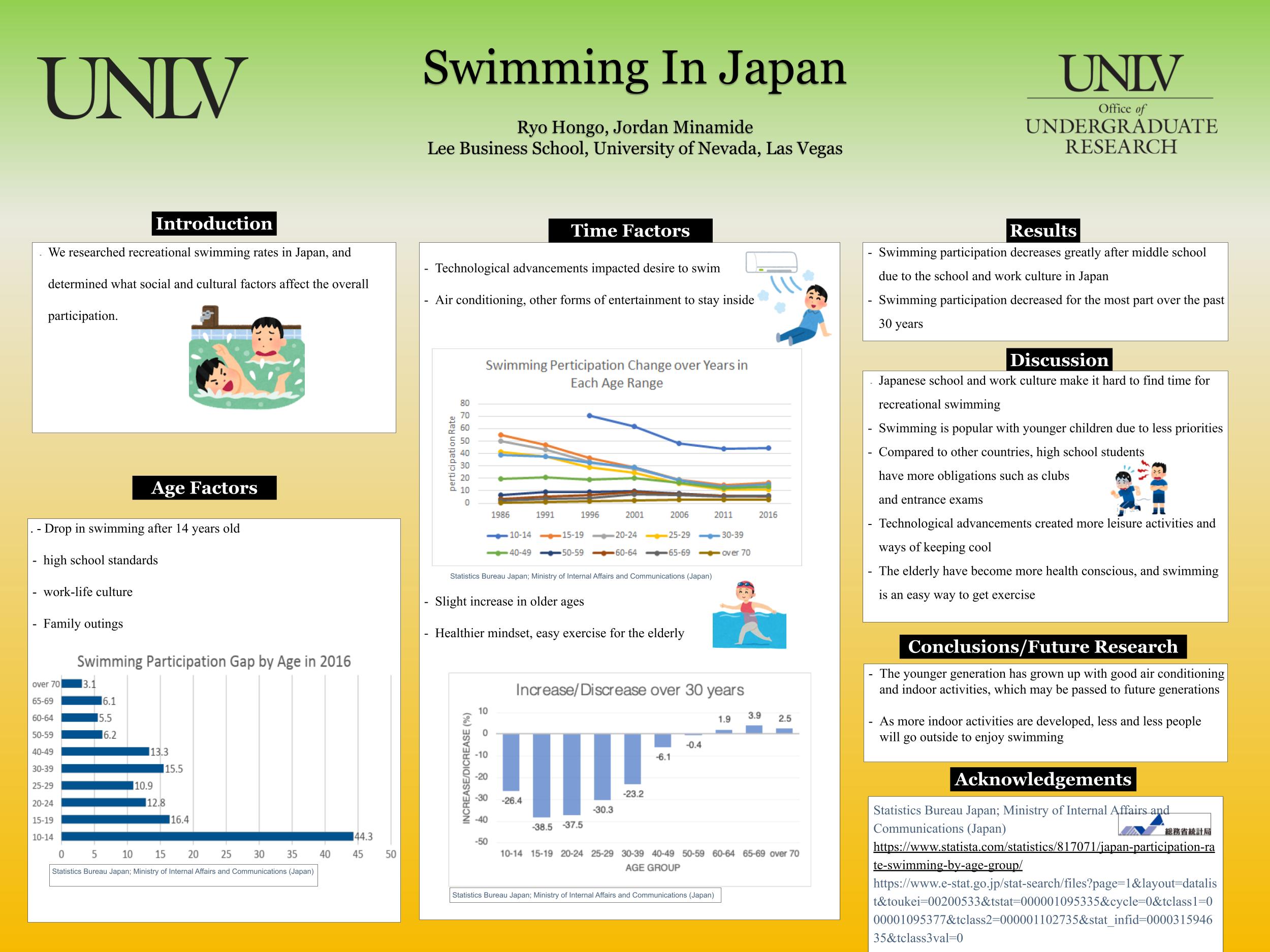
Looking at recreational swimming trends based on age tells us a lot about the priorities that Japanese people have as they grow older. In addition, the amount of recreational swimming has changed a lot in the past 30 years. The numbers for swimming drop significantly as people get older in Japan, as well as have dropped by over 50% in the past 30 years for most age ranges.
Looking at various data sets from surveys conducted by the Ministry of Internal Affairs in 2016, we see that the amount of swimming drops dramatically after age 14, and the amount of swimming has also been decreasing since 1986 for some age groups, and increasing for others. For each age range, this drop shows Japanese school and work culture, where there is little time for recreational swimming. Most middle schools have their own pool where kids can swim. However, in high schools clubs and extra classes take significant time from students. At work, people stay for long hours, and rarely have time to go to public pools.
Since 1986, the amount of swimming has decreased a lot for most age ranges because there are other activities available such as indoor activities due to better air conditioning. There is an exception to this though. The amount of recreational swimming for people over 60 has slightly increased because the older population is becoming more health conscious. This data represents the Japanese lifestyle, and gives an insight of the culture surrounding recreational activities in Japan.

AHS-P4-4. How The Pandemic Has Affected Christmas in the UK


Madeline Novak1
Salem Santacruz2
Faculty Mentor: Kimberly Nehls, Ph.D.3
1Lee Business School, Department of Finance
2Lee Business School, Department of Accounting
3Lee Business School, Department of Marketing and International Business

ABSTRACT
Christmas is the day in which many religious people commemorate the birth of Jesus Christ. Traditionally speaking, many celebrate Christmas by giving gifts and spending time with their loved ones. On average, British consumers spend at least 500 pounds on Christmas presents. But during 2020, companies felt the financial impact of the pandemic, where most consumers spent only 400 pounds, some regions even as low as 300 pounds. In a survey conducted, approximately 39 percent of respondents felt worried about their financial situation during Christmas. These findings suggest that while Christmas is a joyful season, it can also be a time of financial stress, and the pandemic only hardened the decisions that consumers had to make. We will compare 2019 sales to 2020 sales to analyze how the pandemic has affected not only companies profits but consumers spending habits as well.

HNSE-P6-2. Coral Bleaching


Anja Marcusiu1
Noah Ly1
Faculty Mentor: Kimberly Nehls, Ph.D.1
1Lee Business School, Department of Marketing and International Business

ABSTRACT
Coral reefs are a fundamental part of the world’s ecosystem; however, they are hidden in the ocean’s depths, which makes it difficult to see how they are affected by climate change. When under certain pressures, such as warmer temperatures, coral undergoes a process called bleaching. This causes coral to expel their algae, resulting in the loss of their energy source and vibrant colors. As climate change continues to intensify, the frequency and severity of coral bleaching events threaten the recovery and adaptation of coral species. The Great Barrier Reef, the world’s largest coral reef system off the east coast of Australia, has undergone aerial surveys and underwater assessments to measure the corals’ levels of heat stress and bleaching thresholds. Ultimately, the data reveals that increased heat stress leads to greater coral mortality. Similar to most species, some corals are more adaptive, while others are more vulnerable. Therefore, it is critical to understand the composition of each coral species and how they differ around regions of the world to determine what proactive measures should be taken to preserve the ocean’s ecosystems.

AHS-P7-2. Disability and Impairment of the Hand: Trauma Analysis of the Erie County Poorhouse Cemetery


Sydney Layne1, 2
Katherine Gaddis, M.A.1
Faculty Mentor: Jennifer Byrnes, Ph.D.1
1College of Liberal Arts, Department of Anthropology
2College of Liberal Arts, Department of Psychology

ABSTRACT
Hands are one of the most frequently used parts of the body and, as such, are historically and intrinsically linked to daily functioning and the ability to work. Thus, the bioarchaeological analysis of hand bones can prove to be a useful resource in evaluating the lived experiences of past peoples. The current study analyzes antemortem hand trauma observed in individuals exhumed from the Erie County Poorhouse Cemetery (1851-1913), located in Buffalo, New York. In doing so we investigate patterns of trauma distribution and subsequent severity of impairment of the hand. These impairments are then used as a window into the occupational realities of the institutionalized poor in an Industrial Revolution era urban setting. Of the 271 individuals with observable hand bones, 42 (15.5%) displayed trauma in the form of a bone fracture, avulsion fracture, or joint dislocation. There were 55 females and 109 males, of which 5 (9%) and 24 (22%), respectively, displayed trauma. This was a statistically significant difference in trauma occurrences (X2 (1) = 4.197, p = .040). These findings likely reflect occupational differences between men and women. When comparing hand trauma by side (e.g., left and right hand), a significant difference was found with more trauma on the right (t = -1.972; p = 0.049). Impairment scoring of the injuries revealed that individuals suffered mild impairment and subsequent disability of their hand(s). These impairments may be indicative of the hazardous, often unregulated workplace conditions of the time as well as potential instances of interpersonal violence.

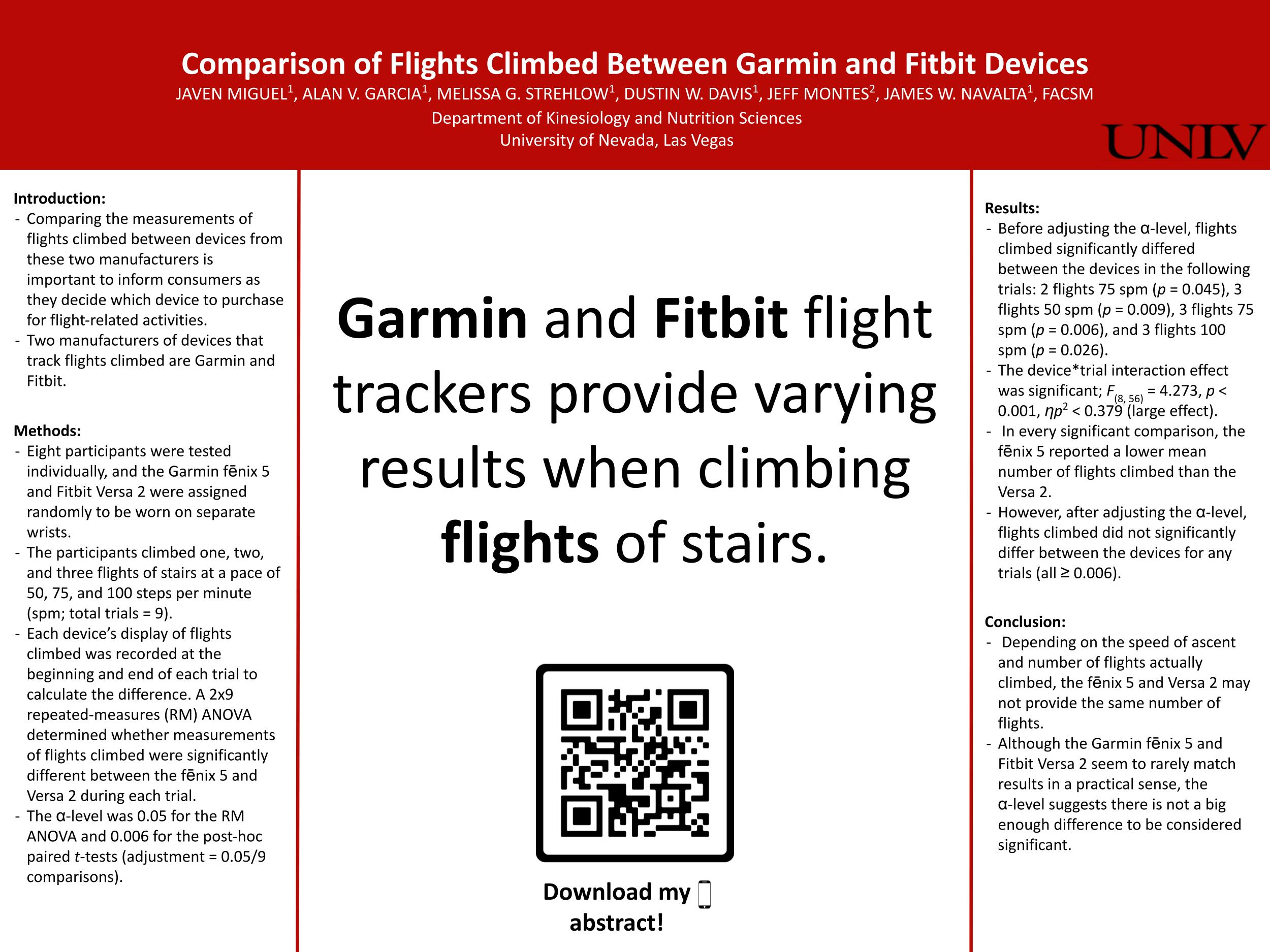
HNSE-P6-1. Comparison of Flights Climbed Between Garmin and Fitbit Devices


Javen Miguel1
Alan Garcia2
Melissa Strehlow2
Dustin Davis2
Jeff Montes3
Faculty Mentor: James Navalta, Ph.D.2
1School of Public Health, Department of Environmental and Occupational Health
2School of Integrated Health Sciences, Department of Kinesiology and Nutrition Sciences
3Monmouth College, Department of Kinesiology

ABSTRACT
With exercise device technology and consumer interest in the field growing, it is important for users to be confident that their wearable fitness devices accurately track their flights climbed. Two manufacturers of devices that track flights climbed are Garmin and Fitbit. Comparing the measurements of flights climbed between devices from these two manufacturers is important to inform consumers as they decide which device to purchase for flight-related activities. PURPOSE: The purpose of this study was to compare the measurements of flights climbed between the Garmin fēnix 5 and Fitbit Versa 2. METHODS: Eight participants were tested individually, and the two devices were assigned randomly to be worn on separate wrists. The participants climbed one, two, and three flights of stairs at a pace of 50, 75, and 100 steps per minute. Each device’s display of flights climbed was recorded at the beginning and end of each trial. A 2×9 repeated-measures ANOVA determined whether measurements of flights climbed per trial were significantly different. The α-level was 0.05 for the ANOVA and 0.006 for the post-hoc t-tests. RESULTS: Before adjusting the α-level, flights significantly differed between the devices in 4/9 trials. In every significant comparison, the fēnix 5 reported a lower mean number of flights climbed. However, after adjusting the α-level, flights climbed did not significantly differ between the devices for any trials. CONCLUSION: Depending on the speed of ascent and number of flights climbed, the fēnix 5 and Versa 2 may not provide the same number of flights.

AHS-P3-4. Portugal’s Home Ownership Rates with Covid-19


Stanley Henderson1
Faculty Mentor: Kimberly Nehls, Ph.D.1
1Lee Business School, Department of Marketing and International Business

ABSTRACT
Home ownership is a necessity to all people and with the recent global economic implications of Covid-19 this has become more difficult. This study will aim to explore the associations between the negative economical implications of Covid-19 and home ownership rates in Portugal. I analyzed home ownership rates in Portugal and economic statistics of Portugal including, unemployment rate, GDP, and core inflation from 2018-2020. Historical statistical information from Portugal was collected and observed to find patterns or correlations between Portugal’s home ownership rate and their economy following the Covid-19 pandemic. Portugal saw its’ home ownership rate drop by nearly a percent (0.8) from 2018-2020. Portugal’s GDP, which accounts for 0.2% of the world’s GDP dropped by over $10 Billion dollars from 2018-2020, while the country had an inflation rate of 1.5% in 2020, the highest in three years prior. Unemployment rates peaked at 8% in 2020. During the Covid-19 pandemic Portugal’s economy was impacted negatively and its’ home ownership rate followed suit. Portugal will need to look at lowering unemployment rates first to kickstart their economy into the post-pandemic era and ultimately bring home ownership rates up.

AHS-P3-6. LGBTQ Community in Korea


Cindy Huang1
Faculty Mentor: Kimberly Nehls, Ph.D.2
1Lee Business School, Department of Accounting
2Lee Business School, Department of Marketing and International Business

ABSTRACT
This research study pertains to the conservative views in Korea based on people’s sexuality (LGBTQ). The goal is to understand Korea’s history, political influence, and cultural background on why their views differ from the rest of the world in terms of discrimination against the LGBTQ community.
I analyzed the history of LGBTQ in Korea, including the Seoul Queer Parade. I also analyzed Korean politics that have a huge effect on people’s opinions and cultural views. Additionally, I looked for the reasoning behind their social and cultural views on why they have homophobia and why they feel the need to result in violence, inappropriate or rude commentary, and sexual harassment.
Statistically, we can see that out of 8,336 people in South Korea who have taken the survey, 57% are still opposed to the LGBTQ community. It has gradually decreased over the years since 2013 by around 5%. Lesbians feel the need to balance their safety and visibility as they are targeted by Anti-LGBTQ activists. There are contemporary social movements in South Korea that exist to prove that same-sex marriages are formed due to the same type of love that heterosexual people have.
I conclude that the LGBTQ community within Korea is generally in danger, hence why most LGBTQ identified people choose to hide their sexuality. The conservative views in Korea are still causing homosexuality to be seen as abnormal. However, Korea is slowly accepting the LGBTQ community overtime thanks to the international influence that proves that the community exists.

AHS-P3-7. China’s Important 2060 Carbon Neutrality Goal


Jason Jasper1
Faculty Mentor: Kimberly Nehls, Ph.D.2
1Lee Business School, Department of Management, Entrepreneurship, and Technology
2Lee Business School, Department of Marketing and International Business

ABSTRACT
Climate Change is a serious threat to global security and well-being. Many developed nations and some developing nations have made promises to become carbon-neutral (net zero emissions), or carbon-free by a specified timeframe. China is a developing nation with high growth and has set a goal to be carbon-neutral by 2060. This study aims to determine how much China would need to reduce CO2 emissions to achieve this goal, and how it compares to other nations, using the most current data, and mathematical analysis. China produces the most CO2 in the world, almost twice as much as the United States, and accounts for 28 percent of world CO2 emissions. China would have to eliminate almost 500 million tons of CO2 emissions year over year to meet the 2060 goal. This represents an enormous challenge, especially considering China’s CO2 emissions are still growing, but will be crucial to ensuring keeping total global temperature rise to 1.5-2 Celsius.

css.php