AHS-P4-1. Italian Mafia and the Impacts it has on Society Today

Joshua Jordan1
Faculty Mentor: Kimberly Nehls, Ph.D.2
1Lee Business School, Department of Management, Entrepreneurship, and Technology
2Lee Business School, Department of Marketing and International Business

ABSTRACT
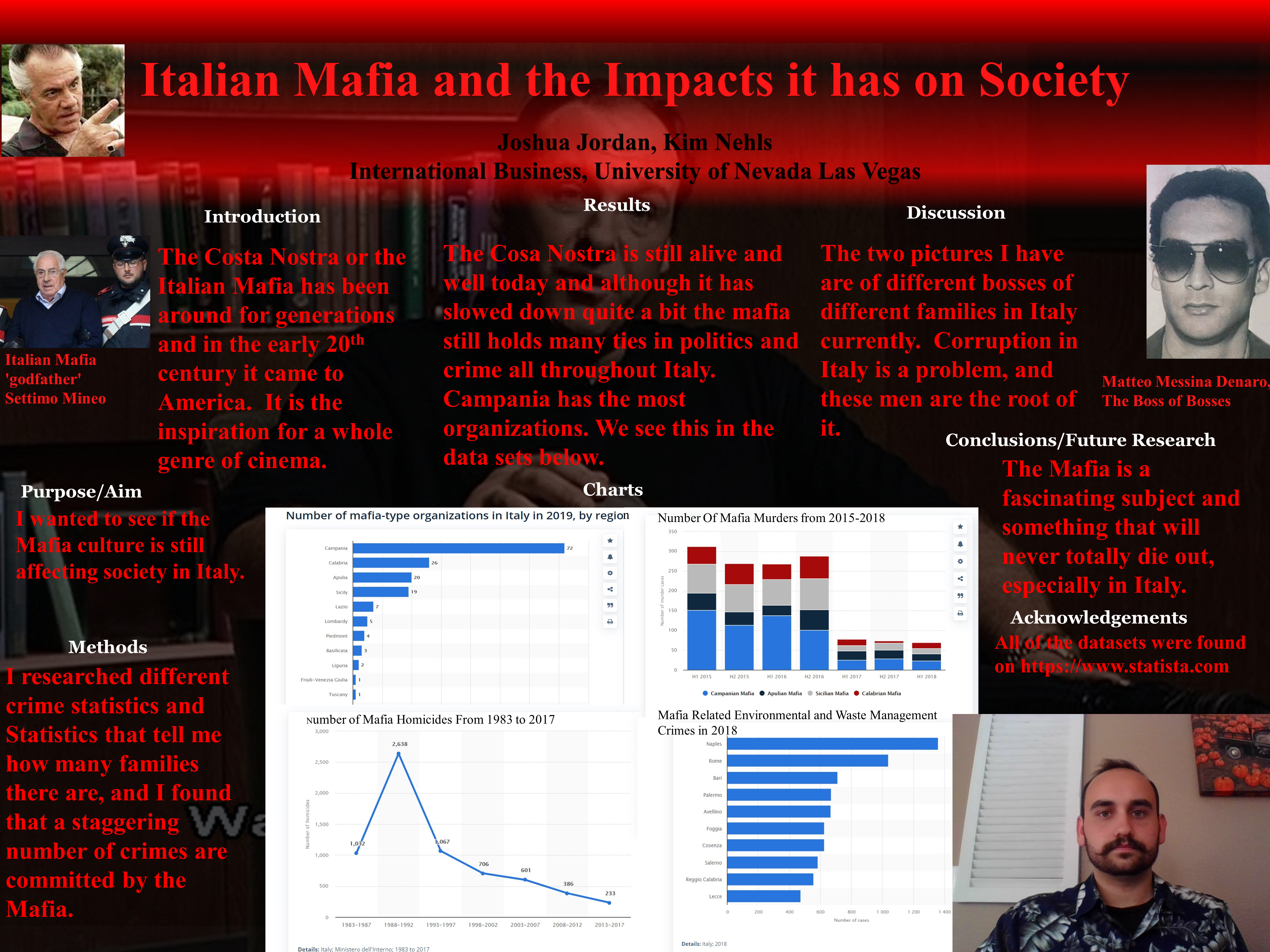
Cosa Nostra, or the Italian Mafia, the roots of the American mob and that way of life lead to the inspiration to the Godfather and so many movies. This Digital research poster dives into the state of affairs of the Cosa Nostra in Italy. How many organizations there are, were, and will be. It also studies the immense effect the mafia has on crime in Italy from homicides to corruption. This poster looks into five different data sets over the years focusing on the relationship between what type of crime is being committed to the potency of the mob at that time. Although the amount of crime and the number of families have gone down significantly since the ’80s. The mafia in Italy is still alive and well compared to its counterpart in the states, with, crimes such as homicides, murder, extortion, gambling, and so on.

HNSE-P3-3. Synthesis of Novel Fluorescent Molecular Probes for the Diagnosis of Alzheimer’s Disease


David King1
Faculty Mentor: Pradip K. Bhowmik, Ph.D.1
1College of Sciences, Department of Chemistry and Biochemistry

ABSTRACT
Alzheimer’s disease (AD) is a detrimental, progressive neurodegenerative disease that is regarded as the most common and pervasive form of dementia, affecting an estimated 1 in 14 people over the age of 65 and 1 in every 6 people over the age of 80.1,2 Diagnosing AD at the proper time poses a great challenge in the current clinical setting. Traditional methods for the diagnosis of AD are expensive, provide poor resolution, and involve toxic radioactive materials. This study aims to synthesize a class of novel fluorescent molecular probes that can bind to the protein-plaques that are caused by the onset of AD to ultimately provide a safe and effective method to diagnose the early stages of AD through improved in vivo imaging, potentially becoming an indispensable tool for diagnosis. The final fluorescent molecular probe was synthesized from a simple Sn2 reaction involving a precursor and was characterized using 1H and 13C nuclear magnetic resonance spectra, elemental analysis, thermogravimetric analysis, and solubility properties. The resultant fluorescent molecular probe was successfully synthesized and emits white-light fluorescence in the solution-state when dissolved in water, making it suitable for aqueous systems. Further studies can be expanded upon for in vivo imaging studies, toxicity, and suitability for the clinical setting.

AHS-P2-8. The Mexican Housing Market: An Analysis for Those Seeking to Buy Real Estate Property to Live in or Invest


Polly Flores1, 2
Faculty Mentor: Kimberly Nehls, Ph.D.3
1Lee Business School, Department of Finance
2Lee Business School, Department of Economics
3Lee Business School, Department of Marketing and International Business

ABSTRACT
This research aims to investigate and better understand the Mexican Housing Market and provide information geared towards fundamental knowledge and or potential investment opportunities within the Mexican housing market. The focus is on the average housing price per Mexican State, the five highest, lowest, and the five leading travel destination states in Mexico. The median days on the market of the Mexican Housing Inventory and the increasing value of the residential market in Mexico were analyzed to give guidance for those interested in this market. Survey time period Data was collected, reviewed, and analyzed. Results show that the National Average price was $1,310,750.00 MXN ($64, 700.00 USD). The median days on the market have ranged from 22.5 days to 70 days since January 2021. The projected value of the residential real estate market for 2021 is $41.3 billion USD and is forecasted to continually grow in the coming years with a speculated $60 billion USD in 2025. The research shows that the Mexican housing market is growing and can be a competitive alternative for those looking to buy real estate property to live in or invest.

AHS-P1-5. Motor Vehicle Sales in China


Cody Felix1
Faculty Mentor: Kimberly Nehls, Ph.D.2
1Lee Business School, Department of Management, Entrepreneurship, and Technology
2Lee Business School, Department of Marketing and International Business

ABSTRACT
With the advancement of electronic and new energy vehicles, motor vehicles are becoming more obsolete as the years progress. China is currently the leading producer and sales of vehicles in the world. Motor and combustion engine vehicles populate a lot of chemicals into the atmosphere compared to those of new energy vehicles. The study will investigate the sales of motor engine vehicles in China and the possible factors that can be influencing the sales. This research will look into factors like the unemployment rate and the development of new energy vehicles.

HNSE-P4-8. Predicting Variant Pathogenicity with Machine Learning


Zachary FitzHugh1, 2
Fatma Nasoz, Ph.D.3
Faculty Mentor: Martin Schiller, Ph.D.4
1Howard R. Hughes College of Engineering, Department of Computer Science
2Lee Business School, Department of Economics
3The Lincy Institute
4College of Sciences, Nevada Institute of Personalized Medicine

ABSTRACT
There are roughly 22,000 protein-coding genes in the human body, many of which play important roles in biological functions. The proteins fold in 3D space, and this is most often necessary for function. A genetic variant can disrupt the secondary structure of a protein (one aspect of structure) or eliminate a site important in protein-protein interaction or post-translational modification. The loss of function or deregulation can result in disease. Thus, there is great biomedical interest in identifying disease-causing single-nucleotide variants.
We hypothesize that we can accurately predict variant pathogenicity. We used machine learning to predict the pathogenicity of a set of 28,369 single-nucleotide variants across 10 genes. The data are acquired from publicly available saturation mutagenesis data sets, which generate every possible amino acid substitution at every position in a protein. Our approach employs a support vector machine using linear, polynomial, and RBF kernel functions. The problem is implemented as a binary classification problem, where a label of 1 indicates a disease-causing variant and a label of 0 indicates a benign variant. The model predicts pathogenicity based on amino acid, post-translational modification, and secondary structure information. We cleaned and analyzed the data with custom Python scripts. Our results show average balanced accuracy scores for classifying pathogenicity of approximately 57.9%, 60.3%, and 60.3% for the linear, polynomial, and RBF kernels, respectively. Therefore, the model is an improvement over random guessing but has room for improvement.

AHS-P3-2. Unsustainable Fast Fashion in the United States


Itzel Gutierrez1
Faculty Mentor: Kimberly Nehls, Ph.D.1
1Lee Business School, Department of Marketing and International Business

ABSTRACT
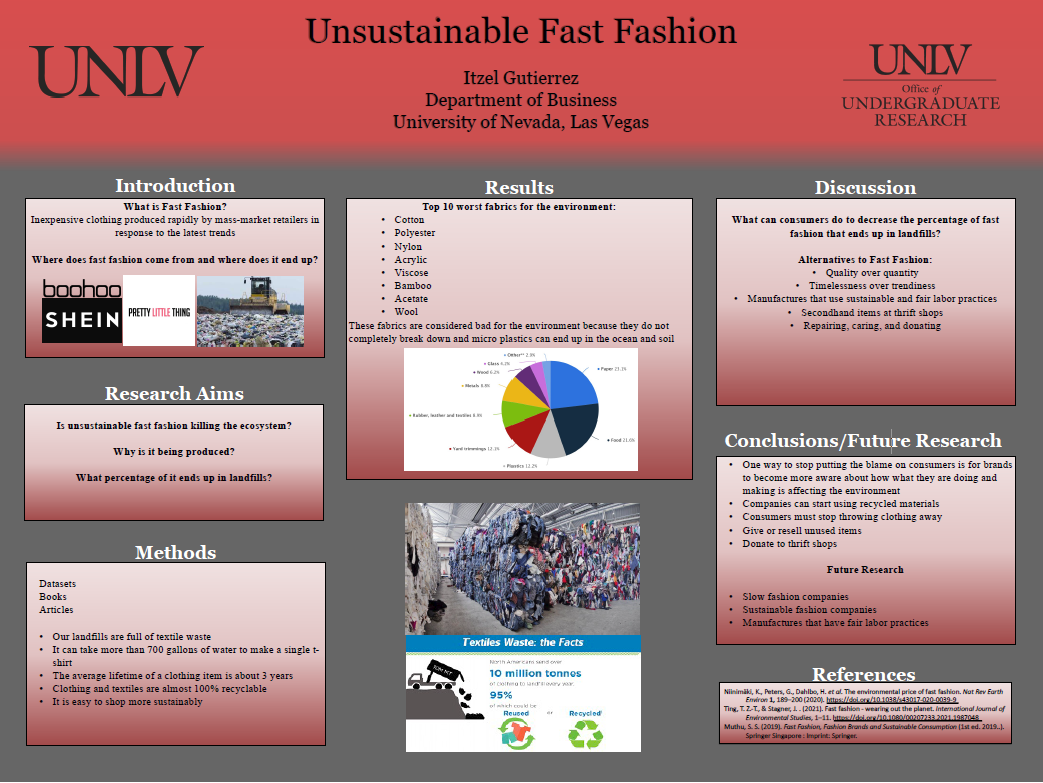
My research will be focused on how unsustainable fast fashion is killing the ecosystem, whether or not it is bad for the environment and what percentage of it ends up in landfills? Boohoo, Shein and PrettyLittleThing are popular fast fashion retail apps among U.S consumers, cheap fast fashion tends to encourage consumers to over buy. My research will start with where does fast fashion come from and where does it end up? Fast fashion is based on trends going on in the red carpet, fashion shows or influenced by social media. Throwing away clothes because it is out of style should never be an option. Once people are done with a piece of clothing, they can give away their items, donate to thrift stores, or even resell their items. My research will explore ways on what consumers can do to decrease the percentage of fast fashion that ends up in landfills. The top 10 worst fabrics for the environment include cotton, polyester, nylon, acrylic, viscose, bamboo, acetate, and wool. These fabrics are considered bad for the environment because they do not completely break down and some micro plastics can make their way into the ocean and soil. One way to stop putting the blame on consumers is for brands to become more aware about how what they are doing and making is affecting the environment.

AHS-P3-3. Mexico Natural Disasters


Haley Hanners1
Nicholette Olson1
Faculty Mentor: Kimberly Nehls, Ph.D.1
1Lee Business School, Department of Marketing and International Business

ABSTRACT
For centuries Mexico has faced numerous natural disasters that have taken a toll on the country’s economy, human capital, and left the country in a state of uncertainty. When most people think back to some of the most devastating tragedies in Mexico, they may reflect on those such as Hurricane Wilma or the 1985 Earthquake. However, the Covid-19 pandemic may quickly surpass previous natural disasters and continue to contribute to the financial hardships in Mexico. Both qualitative and quantitative data show that Covid-19 has cost the country millions of dollars in healthcare, unemployment, and other additional expenses, leaving the country in a state of financial instability. As Covid started to become the global epidemic it is today, the unemployment rate in Mexico began to increase, increasing over one percent from May to June 2020. As of January 18, 2021, the cost of the pandemic has already reached 924 million dollars, nearly reaching the cost of the 1985 earthquake. The average cost to treat Covid in Mexico is $20,000, more than many people make in a year in Mexico. At-home treatment also costs around $3,000. Families have been financially ruined trying to fight for their loved ones’ lives. If continuing at this rate the Covid-19 pandemic will surpass the 1985 Earthquake and Hurricane Gilbert in cost. This intense financial burden on the country and its citizens can leave the country heavily damaged in the short and long term future.

AHS-P2-6. The Relationship of Growing Deforestation Rates in the Brazilian Amazon and Various Factors


Kyra Dias Audino1
Paul Wolf1
Faculty Mentor: Kimberly Nehls, Ph.D.2
1Lee Business School, Department of Accounting
2Lee Business School, Department of Marketing and International Business

ABSTRACT
In Brazil, the Amazon rainforest covers a massive area. Spanning five million square kilometers, it is frequently referred to as the “lungs of our planet”. In June of 2021, a report portrayed the deforestation area in the Brazilian Amazon from 2004 to 2020. The data provides an objective view of the growing problem of deforestation in the Amazon. This paper will uncover the factors related to the increasing rate of deforestation. To uncover these factors, our research will determine which years held the biggest year-over-year rate increases, and we will then research changing economical, cultural, and political factors that could contribute to increases in the deforestation rate. In referencing the deforestation rates, it was determined that in 2016 and in 2019 there were major increases to deforestation. It was found that, in 2016, there were increased demands of crude oil in the US that drove increased deforestation. Additionally, in 2018, Jair Bolsonaro became the Brazilian president and rolled back environmental protection laws which lead to increased deforestation. In conclusion, 2020 saw Brazil report the largest area of primary forest loss. The implications of Amazon deforestation relate to climate change, endangered species, and conservation of ecosystems. Unfortunately the fate of the Amazon rainforest is tied to the overall state of political and economical mindsets in Brazil. In order for the fate of the Amazon to be rectified, a global effort should be made in order to enact laws to ensure the Amazon can remain the “lungs of our planet.”

HNSE-P3-6. Damaging Tobacco Mosaic Virus Using Electrochemistry: A Novel Method to Synthesize High-Quality Vaccines


Angelica Diaz Tremillo1
Kevin Ayala Pineda1
Cory Rusinek, Ph.D.2
Drake Joseph1, 3
Nicholas Pudar4
Faculty Mentor: Michael Pravica, Ph.D.1
1College of Sciences, Department of Physics and Astronomy
2College of Sciences, Department of Chemistry and Biochemistry
3Howard R. Hughes College of Engineering, Department of Electrical and Computer Engineering
4School of Integrated Health Sciences, Department of Health Physics and Diagnostic Sciences
5College of Sciences, Department of Mathematics

ABSTRACT
As a result of the COVID-19 pandemic, it is imperative to develop novel and rapid ways to synthesize highly targeted and effective vaccines. We report a study that tested the effectiveness of using electrochemistry to damage the Tobacco Mosaic Virus (TMV). We hypothesized that by utilizing the acidic properties of DNA and RNA contained by viruses, viral genetic material can be selectively denatured using electrochemistry. We also hypothesized that the viral capsid would be less damaged due to its non-acidic properties and thus the intact capsid could be used as a vaccine vector to promote immune system response. We tested TMV potency by infecting pinto bean seedlings with electrochemically treated and untreated TMV and observed their growth for four weeks. Various spectroscopic techniques such as Nuclear Magnetic Resonance Spectroscopy (NMR) and Ultraviolet-Visible (UV-Vis) Spectroscopy were implemented to assess changes in the electrochemically-treated viruses. Finally, Cyclic Voltammetry (CV) was used to examine oxidative damage in the samples. It was observed that plants infected with electrochemically-treated TMV developed significantly fewer necrotic lesions compared to plants infected with untreated TMV. We also found significant changes in the UV-Vis spectral peaks, NMR spectral peaks, and cyclic voltammograms before and after electrochemical damage. Preliminary results were obtained which suggest that the electrochemical techniques used in this study effectively damaged the TMV virions. Through further testing and improvements, this innovative technique could be used to develop highly targeted and effective vaccines.

This research was funded by UNLV’s TRIO McNair Scholars Institute, which is housed within UNLV’s Center for Academic Enrichment and Outreach and funded under the TRIO Ronald E. McNair Postbaccalaureate Achievement Program by a grant (P217A170069) from the U.S. Department of Education. 

AHS-P7-1. Queering the Narrative: A Review of Interpersonal and Structural Vulnerabilities Faced by Transgender Americans


Adrianne Dizon1
Taylor Flaherty2
Faculty Mentor: Jennifer Byrnes, Ph.D.2
1College of Sciences, Department of Life Sciences
2College of Liberal Arts, Department of Anthropology

ABSTRACT
Transgender and Gender Expansive (TGE) Americans face immense structural vulnerabilities, including difficulties in employment, legal protection, and equitable healthcare accessibility. TGE individuals also experience interpersonal violence through verbal or physical harassment, discrimination, hate crimes, and sexual assault.[1,2] Further, race and gender coalesce to create intersecting identities; for example, TGE women of color are the most at-risk group regarding socioeconomic status, immigration, incarceration and education.[3,4] The TGE population also suffers from a shorter life expectancy (x̄=28.2 years)[5] compared to the average U.S. life expectancy (78.9 years).[6] Unfortunately, the lack of standardized data collection prevents comprehensive analyses of the effects of structural and interpersonal violence on the TGE community.[4] To catalyze a more thorough understanding of this topic, a literature review was conducted to analyze key themes surrounding TGE lives. Studies from the last 10 years were collected using the keywords “structural vulnerability,” “interpersonal violence,” and “transgender.” Twenty-two sources were reviewed in which 7 referenced structural vulnerabilities, 6 interpersonal violence, and 9 both factors; all included transgender identities. Four representative case studies were then chosen to illustrate the thematic findings and prevalence of violence.[5] This literature suggests that structural vulnerabilities and violence put TGE individuals at disproportionate risks of lethal violence. Americans should diligently invest in re-education programs, representative legality, and gender-inclusive healthcare. As social justice movements usher global momentum, a standardized database of deceased TGE individuals and appropriate gender identification in the U.S. census must be adapted.

css.php