AHS-P2-7. The Market for Coffee in Finland


Helen Drager1
Katherine Larson2
Monica Quijano2
Faculty Mentor: Kimberly Nehls, Ph.D.1
1Lee Business School, Department of Marketing and International Business
2Lee Business School, Department of Accounting

ABSTRACT
Coffee is one of the most consumed beverages in the world. Finland ranked No.2 on the list of countries that are most addicted to coffee in 2020. The purpose of this research was to find out the impact of coffee consumption on imports, and the projection of the coffee market in Finland for the next decade. We examined data previously reported on various sources. By analyzing the changes in import frequency and share for each of Finland’s main coffee suppliers from 2018 to 2020. This data will then be used to project the future impact on Finland’s coffee importers for the next decade. The data collected on Finland’s main coffee suppliers from 2018 to 2020 will be utilized in a simple linear regression analysis to forecast the relationship between the market for coffee in Finland and coffee imports into the country. While our results are still in process, the coffee market share is expected to grow in Finland. Coffee consumption has a positive impact on imports of the country.

HNSE-P2-2. Towards Drone Assisted Inventory Management


Akshay Dave1
Faculty Mentor: Paul Oh, Ph.D.1
1Howard R. Hughes College of Engineering, Mechanical Engineering

ABSTRACT
Inventory management drone is a software/hardware framework that allows employers to automate their inventory management process. This framework reduces the risk of warehouse-related injuries and replaces some tedious work. Inventory management drones are one of the cheap options in order to automate this type of work. The following work will build on top of a previously published paper in the AANAPISI Journal. The goal of this research is to upgrade the onboard computer and increase the computational capabilities of the drone. By upgrading the computer, the drone’s automation capabilities will be increased. This project will attempt to do longer flight tests and do 3d reconstruction of a mock-up “warehouse.” Lastly, the author will attempt to develop end-user GUI for ease of use.

This research was funded by UNLV’s Title III Part F Asian American and Native American Pacific Islander Serving Institution (AANAPISI) program, which is housed within UNLV’s Center for Academic Enrichment and Outreach and funded under grant (P382B160008) from the U.S. Department of Education.

AHS-P2-5. Impact of COVID-19 on Tourism in Spain


Apoorva Chauhan1, 2
Viviana Avila Gonzalez2
Taylor Nagai3
James Meyer4
Faculty Mentor: Kimberly Nehls, Ph.D.3
1Howard R. Hughes College of Engineering, Department of Mechanical Engineering
2Lee Business School, Department of Management, Entrepreneurship, and Technology
3Lee Business School, Department of Marketing and International Business
4Lee Business School, Department of Accounting

ABSTRACT
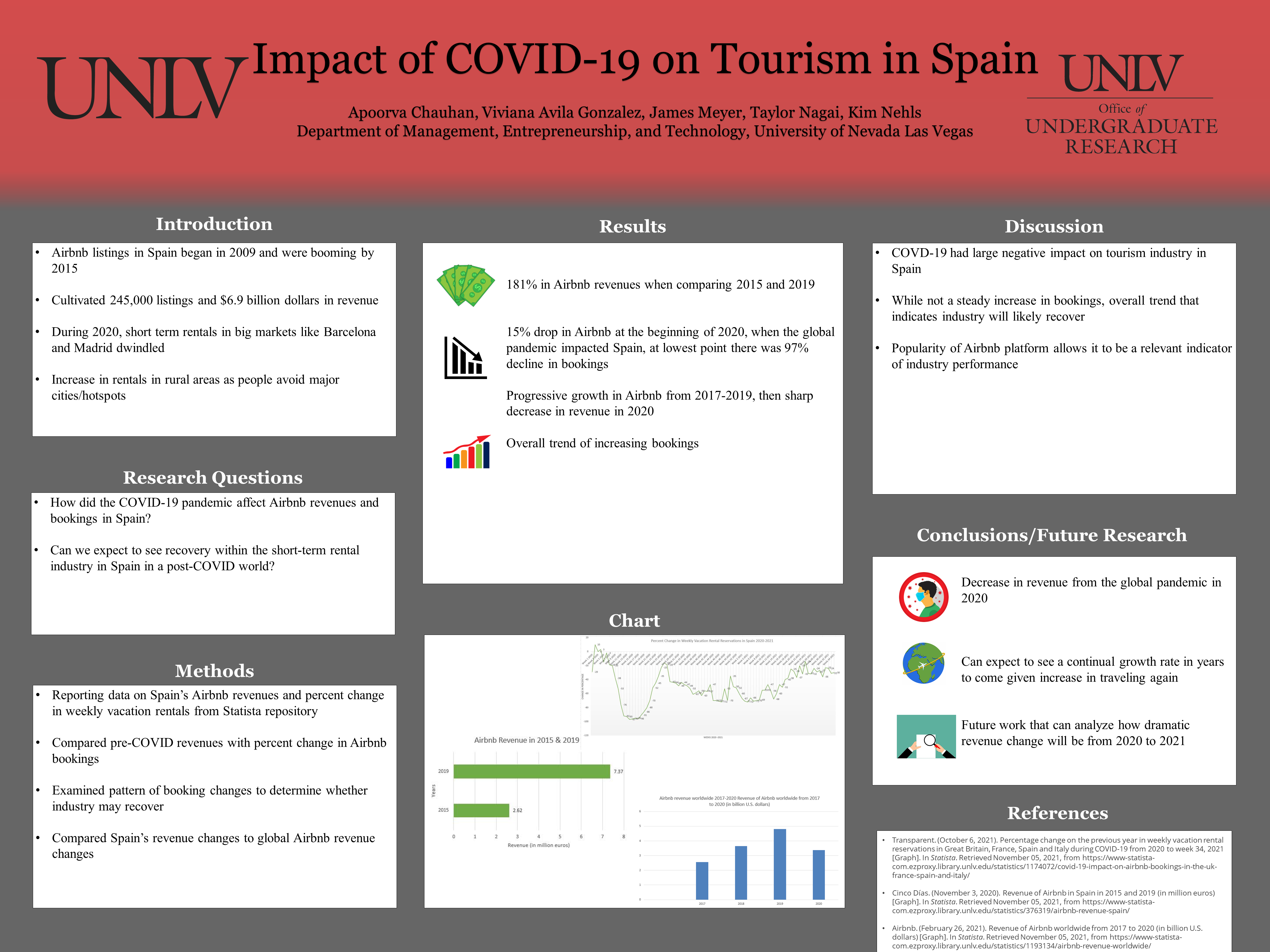
The objective of this analysis was to quantify the effects of the COVID-19 pandemic on the tourism industry in Spain by looking at Airbnb revenues and bookings, and to learn whether the Airbnb data could indicate if the industry was recovering. Airbnb has grown exponentially in popularity since the onset of COVID-19, and looking at Airbnb revenue and bookings may be more indicative of a country’s tourism industry than looking at traditional hotels. Two open source datasets taken from Statista were used in this analysis: Airbnb revenue in Spain from 2015 & 2019 and COVID-19 impact on Airbnb bookings in the GB, France, Spain and Italy 2020-2021. The second dataset was filtered to show only the Spain data. From the first dataset, it can be seen that Airbnb revenue had a 181% increase in the span of four years. From the second dataset, it can be seen that when the first case in Spain was reported on January 31st of 2020, Airbnb bookings had experienced a sharp decline from the previous week, of 15%. After reaching an all time low during the week of March 30th, 2020, with a decline of 97% in bookings, there had been a steady increase until mid July of 2020. While the data is not steadily increasing, the overall trend does show that Airbnb bookings are increasing, though they are still about 20% less than the pre-COVID bookings of 2020. This data corroborates with the increase in tourism to Spain, which is 78% compared to 2020.

AHS-P2-2. Population Changes in the Syrian Arab Republic: 2010-2020


Chasen Billon1, 2
Alessia Borgetti3
Rylee Gomez4
Faculty Mentor: Kimberly Nehls, Ph.D.4
1Lee Business School, Department of Accounting
2Greenspun College of Urban Affairs, Department of Criminal Justice
3Lee Business School, Department of Finance
4Lee Business School, Department of Marketing and International Business

ABSTRACT
This paper intended to study the population-related effects of the Syrian Civil War on the Syrian Arab Republic. The Syrian Civil War that started in March of 2011 is still on-going, along with the associated refugee crisis that arose from it. To determine the extent of the continued crisis, we decided to utilize population data to make inferences related to population growth, decay, and stagnation from the year 2010, through 2020. We found that during the initial stages of the Syrian Civil War, there were significant levels of population decay. However, by as early as 2015, the population decay had slowly begun to lessen, and by 2019, a marginal level of population growth had begun. By 2020, the population growth was nearing pre-war levels, and the level of population growth now makes the Syrian Arab Republic one of the fastest-growing countries worldwide. These findings should allow for a better understanding of the current situation within the Syrian Arab Republic. Particularly, this paper should assist humanitarian groups in understanding where to focus their resources. Additionally, this paper should provide government officials the data necessary to re-shape their policies towards refugee assistance and foreign aid.

HNSE-P3-5. Electrochemical Damage of Biological Matter


Kevin Ayala Pineda1
Drake Joseph1, 2
Nicholas Pudar3
Angelica Diaz Tremillo1
Faculty Mentor: Michael Pravica, Ph.D.1
1College of Sciences, Department of Physics and Astronomy
2Howard R. Hughes College of Engineering, Department of Electrical and Computer Engineering
3School of Integrated Health Sciences, Department of Health Physics and Diagnostic Sciences

ABSTRACT
In the crisis of the coronavirus COVID – 19 pandemic and the urgency of creating quick methods for creating high-quality vaccines, here we present preliminary results that aim at utilizing electrochemistry on a virus with minimal damage to the capsid, and thus target the DNA/RNA to denature the virus. For this project, we worked with biological matter. In this report we discuss the results of DNA and TMV electrochemically damaged in an aqueous solution. The samples were analyzed via Cyclic Voltammetry (CV), NMR, and UV-Vis spectroscopy. The DNA’s fingerprint was significantly altered in all three spectra. Whereas the TMV had significant differences in the CV and NMR but not the UV-Vis spectra.

This research was funded by UNLV’s TRIO McNair Scholars Institute, which is housed within UNLV’s Center for Academic Enrichment and Outreach and funded under the TRIO Ronald E. McNair Postbaccalaureate Achievement Program by a grant (P217A170069) from the U.S. Department of Education. 

AHS-P6-1. Examining the Factor Structure of the Trait Meta-Mood Scale While Accounting for Data Point Censoring


Fitsum Ayele1
Orei Odents1
Faculty Mentor: Kimberly Barchard, Ph.D.1
1College of Liberal Arts, Department of Psychology

ABSTRACT
Meta-mood experience refers to thoughts and feelings that serve to monitor, evaluate, and at times change mood. The Trait Meta-Mood Scale (TMMS) was designed to gauge meta-mood experience along three factors: Attention, Clarity, and Repair. Previous factor analyses have verified this three-factor structure. However, one study by Palmer and colleagues found strong support for a four-factor structure. In light of this discrepancy, the present study aimed to replicate Palmer and colleagues’ study in a new sample, comparing the models they used and determining which is best-fitting. We also aimed to correct the effect of data point censoring when estimating factor models. Data censoring occurs when researchers only have partial information about the value of a variable. 202 college undergraduates completed the TMMS during an online study. To compare the models, we relied on Akaike’s Information Criterion (AIC) and Bayesian Information Criterion (BIC). Results revealed that the four-factor model fit the data better than the three- and one-factor models tested. The first three factors corresponded to the previous Attention, Clarity, and Repair factors. The fourth factor was named Emotional Resilience because the items loading on this factor suggested resistance to negative emotional experiences. We suggest TMMS users calculate scale scores based on all four of these factors to provide a more detailed description of meta-mood experience. Limitations of the present study include the lack of absolute fit measures for the models tested. Future researchers should use other statistical programs to replicate (or extend) our study.

This research was funded by UNLV’s TRIO McNair Scholars Institute, which is housed within UNLV’s Center for Academic Enrichment and Outreach and funded under the TRIO Ronald E. McNair Postbaccalaureate Achievement Program by a grant (P217A170069) from the U.S. Department of Education. 

HNSE-P3-8. Automating UNLV’s Computer Science Mentorship System


Ivan Jasper Aquino1
Spencer Lucci1
Faculty Mentor: Jorge Cacho Fonseca, Ph.D.1
1Howard R. Hughes College of Engineering, Department of Computer Science

ABSTRACT
We live in an era where technology is advancing at a fast rate; these technologies often replace menial tasks such as organizing data in general. As data grows, it can become unmanageable for a normal person to maintain. The purpose of this research is to automate the UNLV Computer Science faculty mentor system so that students can sign up and choose their mentor quickly without the need of human intervention. While doing this practical project we intend to learn key concepts of web design and development along with server management, cybersecurity practices, and practicing the research process of learning and applying technologies to an existing problem. We have researched different technologies and how they work together to prototype this project. This includes finding frameworks to use with front-end development, what database management to use, and back-end API to send out emails. The result shows basic functionality of the application where students input their UNLV student email to receive a link where they can submit their information and their preferred faculty mentor. Another feature that was added is an administrator type of account where UNLV faculty members have control in adding or removing mentors and visualizing the data in a tabular form based on the search criteria. As a result of our project, this will automate administrative tasks in the Computer Science department. If other schools within UNLV adopt a mentorship system, then this project is easily expandable and will prove to be useful in other departments.

HNSE-P1-6. A Review on the Usage of Machine Learning Methods Gait Analysis and Possibility of a Portable Gait Analysis Device


Hassan Adam1
Faculty Mentor: Venkatesan Muthukumar, Ph.D.1
1Howard R. Hughes College of Engineering, Department of Electrical and Computer Engineering

ABSTRACT
Gait analysis is a valuable tool for evaluating and monitoring an individual’s walking pattern, which is used to recognize movement-related irregularities. Lately, machine learning methods have been introduced in the processing of the gait analysis data to help monitor and analyze the data. Given the increased interest in the area, this paper will focus on two parts: one is analyzing and reviewing the latest Machine learning Methods and sensors used, and the second is the possibility of a portable device capable of measuring and processing an individual’s gait. The analysis of the Machine learning models and sensors papers illustrated that several algorithms and methods used had shown a possibility in helping to identify and monitor neurodegenerative disease, which is an excellent area for further research. Additionally, the second part of the study showed that a portable device capable of measuring and processing an individual’s gait is possible and would be capable of data processing onsite. However, that device would have a disadvantage over the conventional gait analysis.

This research was funded by the Southern Nevada Northern Arizona (SNNA) Louis Stokes Alliance for Minority Participation (LSAMP), which is housed within UNLV’s Center for Academic Enrichment and Outreach and supported by a grant (HRD – 1712523) from the National Science Foundation (NSF). Any opinions, findings, and conclusions or recommendations expressed in this material are those of the author(s) and do not necessarily reflect the views of the NSF. 

AHS-P1-8. Geography Illiteracy in America?


Ivan Arrieta1
Faculty Mentor: Kimberly Nehls, Ph.D.2
1Lee Business School, Department of Finance
2Lee Business School, Department of Marketing and International Business

ABSTRACT
By now most people have heard or watched the Jimmy Kimmel skit where he asks multiple Americans to point out a random county only to fail completely, as far as completely forgetting where The United States is on a map. Since the early 1980s US geographic illiteracy has been a topic of discussion, with some calling it a national security threat. This research will address if Americans are geographic illiterate, and whether geography should be taught more in the school systems in an age of globalization. This research sets out to contribute statistical data on how many University of Nevada, Las Vegas (UNLV) students can guess correct locations compared to every day people asked randomly on the Las Vegas Strip. The methodology I took for this research consisted of randomly asking 100 students at UNLV to identify The United States, an eastern state, and Afghanistan on a map. The same experiment was repeated on the Las Vegas Strip. The experiment at UNLV would test if university students score relatively better than average people asked, and the experiment at the Strip would represent the average American many Americans around the US visit the Las Vegas Strip. The results from this research show that almost all Americans can locate The United States, around half can locate an eastern state, but most could not identify Afghanistan. University students do average better results than people on the Strip as hypothesized. This research shows that most Americans aren’t as.

AHS-P2-4. Daum Kakao Gaming Sales 2015-2020


Daniel Castillo1
Faculty Mentor: Kimberly Nehls, Ph.D.2
1Lee Business School, Department of Management, Entrepreneurship, and Technology
2Lee Business School, Department of Marketing and International Business

ABSTRACT
The video game industry is large with many companies having their hands in it. Very notable companies include Sony, Microsoft, Nintendo, and the famous South Korean based company Daum Kakao. In quarter four of 2020 the company made 140.8 billion won just off of its video game branch Daum Kakao Games. 140.8 billion won can be compared to about 119 million USD and that is in a singular quarter. My objective is to analyze why Daum Kakaos Games are so profitable. How gaming companies make a profit depends on what game model they use. Some companies just have the consumer buy the game for a flat amount, some release free games that have microtransactions built in. Daum Kakao has games such as Black Desert Online, PlayerUnknown’s Battlegrounds, Path of Exile, and Eternal Return that they publish. I took a look at these games to see what sort of process they used to have players spend their money on the game and discussed with players of the game why they spend money. After looking into these games and talking with players I found they gain a large amount of their revenue from microtransactions made in game to get special cosmetics for your characters. These games are so profitable and successful in a market because they provide players with a way to customize and express themselves in an appealing way. It also allows them to show off to peers with what exclusive in game items they have obtained.

css.php